Last week, the Australian Financial Review reported that Deloitte cut about 170 jobs in Australia, even as it hires more than 500 people into its managed services division. The firm’s own estimate is the headline: AI will automate about a third of routine consulting tasks, which could push partners to cut fees by up to 40%. In the same week, the AICPA and the AI Underwriting Company said CPA firms are already running a new kind of audit, one that certifies AI systems and agents.
I work as a delivery manager in consulting, so this isn’t abstract for me. Here’s what I’m seeing from the inside.
My status report now interviews me
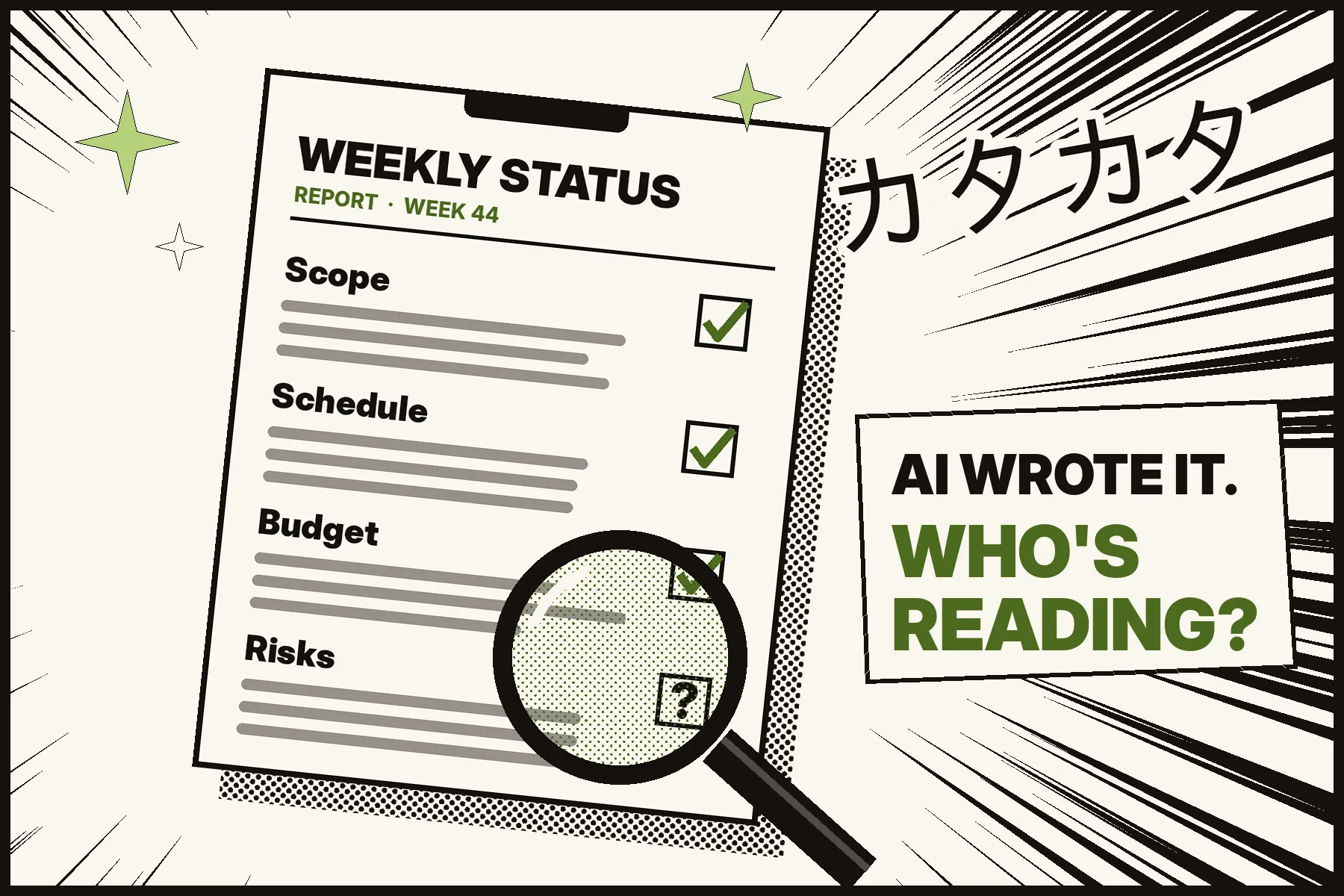
AI is already deeply integrated into my day: status reporting, requirements, testing, estimates, all of it. The best example is the weekly status report. It used to eat a real chunk of my week. Now it’s a few prompts, and I let the AI interview me to pull out what happened, what’s at risk and what’s next.
That time doesn’t disappear. It moves to what matters most to our client: building the right product to solve the right problem.
But AI is not a magic bullet. It gets you close enough, and then you have to put in the time to review what it produced.
Deloitte is right, mostly
A good chunk of our work can be automated, and much of it already is:
- Meeting summaries and follow-up action items
- Risk registers
- Requirements gathering and gap analysis
- Prototyping
- Building decks
Every item on that list is an artifact, though, and every artifact needs human eyes to review and validate it before it goes in front of a customer. A human in the loop isn’t a nice-to-have. It’s a must.
Fixed fees mean precise invoices
In my recent engagements, I’ve seen a small shift toward fixed-fee work. My view is limited, but the implication is clear. When the price is fixed, every invoice that goes to the client has to line up precisely with what was asked for and what was actually delivered. That gap has to be small or non-existent, or invoicing becomes a nightmare.
If AI really does take a third of the routine work, billing by the hour gets harder to defend, and this kind of precision becomes the job.
Onboard AI like a new junior
Think about bringing on a junior or an intern. They’re great at following instructions, but they can’t yet think for themselves. Give them a workflow and they’ll follow it step by step. Run it enough times and they start to see the pattern, and eventually they find ways to improve it on their own.
AI doesn’t pick up the pattern that way. You have to tell it the signals to watch for. So I treat it the same way I’d treat that junior, with one extra step:
- Start with a clear workflow, step by step.
- Spell out the signals it should watch for and flag, because it won’t infer them.
- Put guardrails in place for what it must never do or send without review.
- Only then let it “loose”, once the pattern is formed and the checks are proven.
That’s also why the new AI agent audits make sense to me. Clients will want proof that someone set those guardrails before an agent touched their data.
If you’re starting out in consulting
Deloitte’s move is part of a bigger shift. Managed services, where a firm runs part of a client’s operations on an ongoing contract instead of delivering a one-off project, is growing because AI makes that work cheaper to deliver at scale. For anyone early in their career, here’s what I’d focus on:
- Stay curious. Follow industry trends and keep learning, because the tools change every few months.
- Expect the lines to blur. Technical and non-technical roles are converging like never before, thanks to the AI tools now available to everyone.
- Speak the client’s language. Learn the business terms that resonate with customers, and understand their pain points.
- Think in outcomes. Value-based outcomes, not hours or deliverables, are what clients will pay for.
Five years from now
My hope is simple. AI gets good enough to take away all the administrative work, so we can focus on what matters to the customer: solving the problems in their industry, bringing efficiency to their workflows and, ultimately, making people’s daily lives better, in money saved or otherwise.
Final thoughts
The headlines make it sound like consulting is being automated away. What I see is narrower and more hopeful: the paperwork is being automated, and the judgment is becoming the product.
- If you lead delivery: Use AI for the artifacts, and keep the review. The time you save is only worth something if you spend it on the client’s real problem.
- If you’re early in your career: Learn the business, not just the tools. Anyone can generate a deck now. Few people can tell you whether it’s the right deck.
- If you’re a client: Ask your partners how they use AI and who checks the output. A fixed price is only as good as the precision behind it.
AI can write the status report. Someone still has to read it, understand it, and stand behind it. For now, and I hope for a long while, that someone is us.
Sources: Going Concern on Deloitte’s layoffs and AI agent audits, reporting from the Australian Financial Review and the Journal of Accountancy.