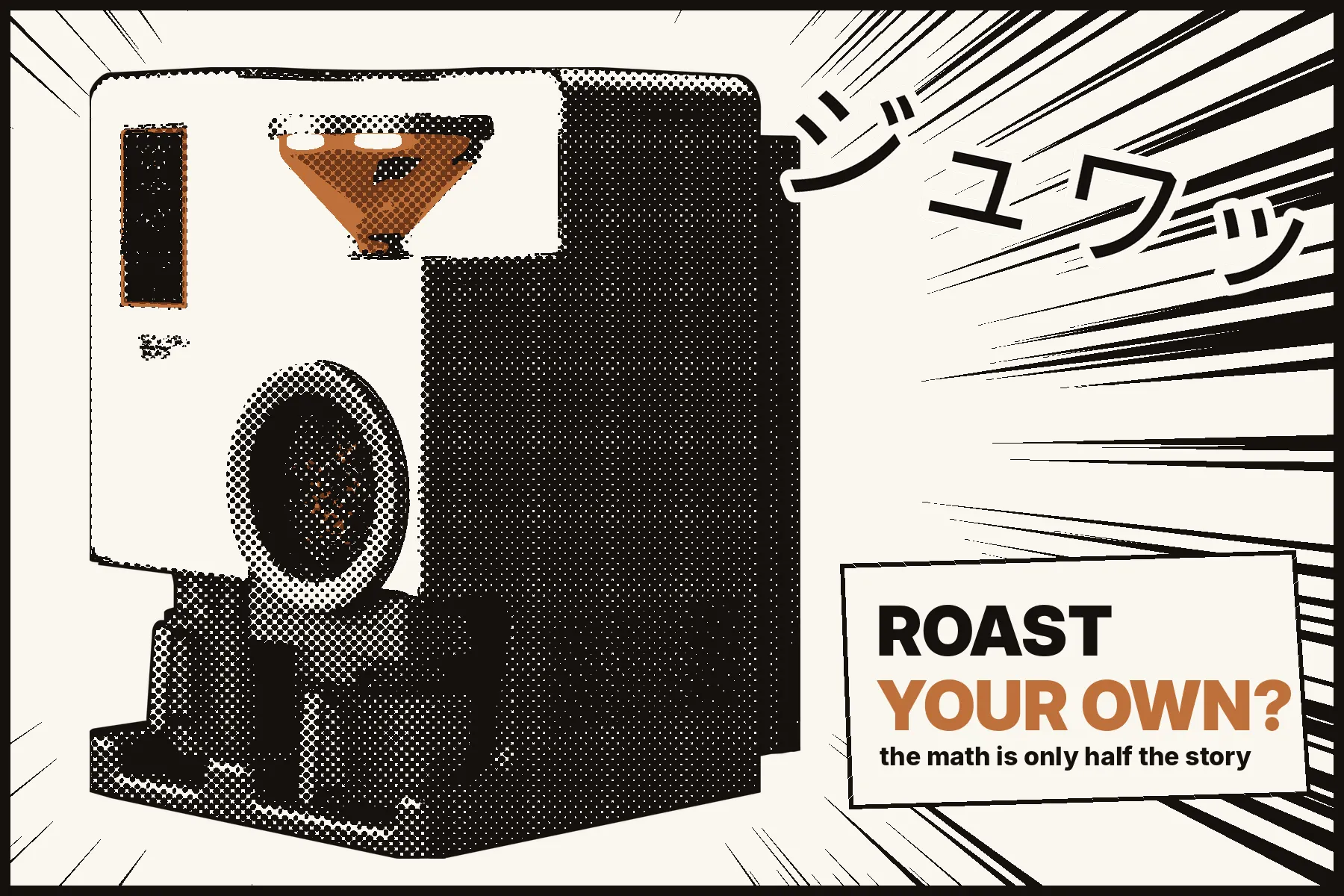
Last week, Bellwether Coffee launched a new electric Shop Roaster for cafés, along with a bold claim: roast in-house and you can cut your coffee costs roughly in half. Their numbers say the median café buying wholesale specialty coffee pays $14.80 a pound, more than a third pay $18 or more, and the modelled payback on the roaster is about five months. That lands in a week when arabica climbed back above US$3 a pound, so the timing is not an accident.
I have roasted my own beans, badly and then less badly, so this one caught my attention.
What roasting at home taught me
I’ve tried both pan roasting and a small drum roaster. On cost, home roasting wins, and it isn’t close: green coffee is far cheaper than roasted, and the cost per cup drops significantly.
On everything else, it’s a different story.
- Time. Dialling in a roast profile is a hobby of its own. Every new bean is a fresh round of trial, error and tasting.
- Smoke. Roasting produces fumes, and indoors, that means a kitchen that smells like a campfire.
- Weather. The textbook answer is to roast outdoors. That works fine until you remember I live in Canada, where we spend about 60% of the year under snow.
So these days, I rotate between roasters and let the professionals deal with the chaff.
The part the spreadsheet leaves out
On the surface, roasting in-house cuts costs, whether you’re a business or a person with a popcorn popper. Wearing my delivery manager hat, though, I’d want to see the rest of the business case:
- Labour. Someone has to prep, roast and clean up, and those are business hours that aren’t spent on the bar or with customers. Roasting is hands-on, too. Each batch needs someone watching it, and the chaff and the roaster itself need regular cleaning and upkeep.
- Scheduling. Roast during opening hours and you pull a person off the bar, usually right when you need them most. Roast before or after hours and you’re paying for extra shifts.
- Skill and training. A good roaster isn’t a barista with a free afternoon. Someone needs to learn the craft, and that learning curve is paid time.
- Key-person risk. If only one person on the team knows how to roast, their vacation or sick day becomes your supply problem. Cross-training a backup doubles the training bill.
- Operations. You need to source green coffee, which means building relationships with green coffee importers and wholesalers, or going direct to farmers and co-ops. Then you need space and a process to store it, and you’re in the packaging business too.
- Quality and food safety. Profiles don’t refine themselves. Test roasts, cupping and tweaking all take ongoing time and skill. And now that you’re “cooking” in-house, food safety comes with it. In most places, that means regular food safety inspections, plus the costs and paperwork that go with them.
To be fair to Bellwether, their roaster is electric and smokeless, with no gas line or venting needed, which solves my kitchen problem for a café. It also ships with preset profiles for their own green coffees, an app to track green inventory, and a packaging program for selling retail bags. But their savings figure is modelled from coffee prices and volumes that users reported, and the announcement doesn’t say whether staff time is counted. The 93% of their customers who now sell bags under their own brand also come from a small survey of the company’s own customers. It’s a good starting point, not the whole answer.
Why a roaster in the corner still matters
When a café has its own roaster, it signals attention to detail. It says, without a word, “we know what we’re doing.”
That doesn’t make partnering with a great local roaster the lesser choice. A café that buys in is free to put its energy into brewing, or into the kind of service that makes people come back. Both are valid ways to run a good shop.
Meanwhile, at the checkout
Coffee prices have been creeping up for a while, and it isn’t just third- and fourth-wave cafés. The bag from the supermarket has gone up too. Craziness.
If I opened a tiny café
My first instinct was to roast my own, because it would give me certainty that the beans in my hopper are exactly the way I intended. On second thought, if the café is tiny, I’d focus on brewing the best coffee I can with beans from roasters who already do this brilliantly. Owning a roaster is a commitment, and a tiny café has only so many hours.
A café that pulls it off
The best example I know is Structure in Montreal, which roasts its own coffee and serves it with the same dialled-in care. I visited last month and wrote about it in Coffee experience in Montreal, and I’m still working through their Discovery Pack at home. It’s proof that when roasting and brewing live under one roof and the team has the time to do both well, you can taste it.
Final thoughts
Roasting in-house can halve what a café pays for beans, but the real question isn’t “is it cheaper?” It’s “what are we best at, and where do we want to spend our hours?” Here’s what I’d take away, whoever you are:
- If you run a café: Build the full business case before you buy the machine. Count the labour, the sourcing relationships, the storage, the inspections and the learning curve, not just the price per pound. If roasting is the craft your team is excited to master, it can become your signature. If it isn’t, partnering with a great local roaster isn’t settling. It frees you to be brilliant at brewing and hospitality.
- If you’re curious about roasting at home: Try it. A pan or a small drum roaster will teach you more about what’s in your cup than any tasting note. Just open a window, maybe wait for spring, and go easy on yourself for the first few batches.
- If you’re simply a coffee drinker: Next time a price creeps up, remember how many hands touched that cup, from the farmer and the importer to the roaster and the barista. Asking where your beans come from, and who roasted them, is a good way to find the cafés worth supporting.
The best cafés I know, whether they roast in the corner or buy from down the street, have one thing in common: they’ve chosen what to be great at, and they do it with care. That’s a lesson that works well beyond coffee.
Sources: Sprudge on Bellwether’s Shop Roaster, Perfect Daily Grind coffee news recap, October 9.
Cover illustration adapted from a Bellwether Coffee product image of the Shop Roaster.